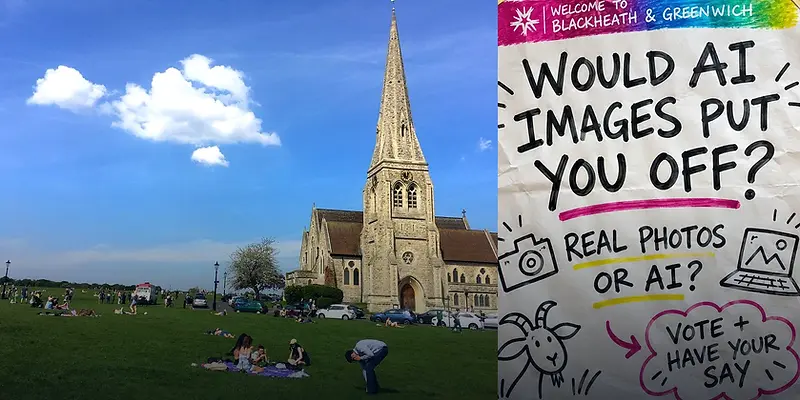
Would AI-Generated Images Put You Off Supporting a Local Business?
Some people won't support businesses using AI-generated images; others say affordable AI design helps independents survive. Compare real Blackheath examples, vote in our poll and join the conversation.
There is a question dividing people across social media: if a local business uses AI-generated posters, photographs or illustrations, would it make you think twice about supporting them?
One recent Facebook discussion attracted an extraordinary range of responses. Some people argued that AI images make every advertisement look the same. Others said the real issue is whether pictures are truthful. And several independent business owners defended using affordable tools when professional creative budgets are beyond their means.
We wanted to bring that conversation closer to home — to the cafés, pubs, charities, markets, community groups, shops and independent publishers of Blackheath, Greenwich and the surrounding neighbourhoods.
Would you judge a business by how it makes its promotional artwork? Or by the experience it actually delivers? We want to hear your views in the reader poll and moderated comments below.
Why do AI posters put some customers off?
Look through the discussion and certain complaints keep appearing: overly glossy designs, identical-looking faces and decorations, excessive effects, cluttered type and a sense that the artwork could belong to almost any business.
Some commenters said an AI-generated food photograph would stop them visiting a restaurant. That reaction raises a substantive issue: if a dish is invented by a computer, what does it tell a customer about the meal they will actually receive?
Photographs of genuine products, hotel rooms and venues can be evidence. Creative illustrations are something different. Problems emerge when imagery blurs the distinction without telling the audience.
A beautifully designed poster for a community theatre is not the same thing as a fictional photograph purporting to show the actual actors, audience or auditorium. The setting, purpose and claims matter.
Other readers raised concerns about the livelihoods of photographers, artists, illustrators and designers — many of whom are independent local businesses in their own right. For them, this debate is about commissions, skill and the future of creative work, not just visual taste.
But what about the cost of running a small business?
There's another perspective worth hearing.
An independent shop or community organisation may need to produce a new event poster every week while also covering wages, energy, rent, insurance and stock. Professional photography and original design can be excellent investments, but not every project has the budget.
One owner in the discussion described having previously spent around £800 per month on a design service before moving to AI-assisted content. That's one individual's account — not a typical market rate — but it illustrates why owners sometimes make this choice.
Imagine a volunteer-run charity promoting a fundraiser, a small café advertising a new menu, or a local club putting on an affordable community event. Is a low-cost poster necessarily a sign they care less about the quality of the activity?
Equally, does buying a tool remove the obligation to communicate clearly, honestly and with some creative thought? Of course not.
Saving money can be understandable. Misleading customers or giving them unusable information is a separate matter.
Look at this: the same real Blackheath photograph, two creative treatments
The first comparison uses the same genuine photograph of All Saints Church and the heath at Blackheath, previously supplied for our local-guide work. One version is the original. The other uses an AI-assisted colour and contrast treatment to make it brighter and more eye-catching.
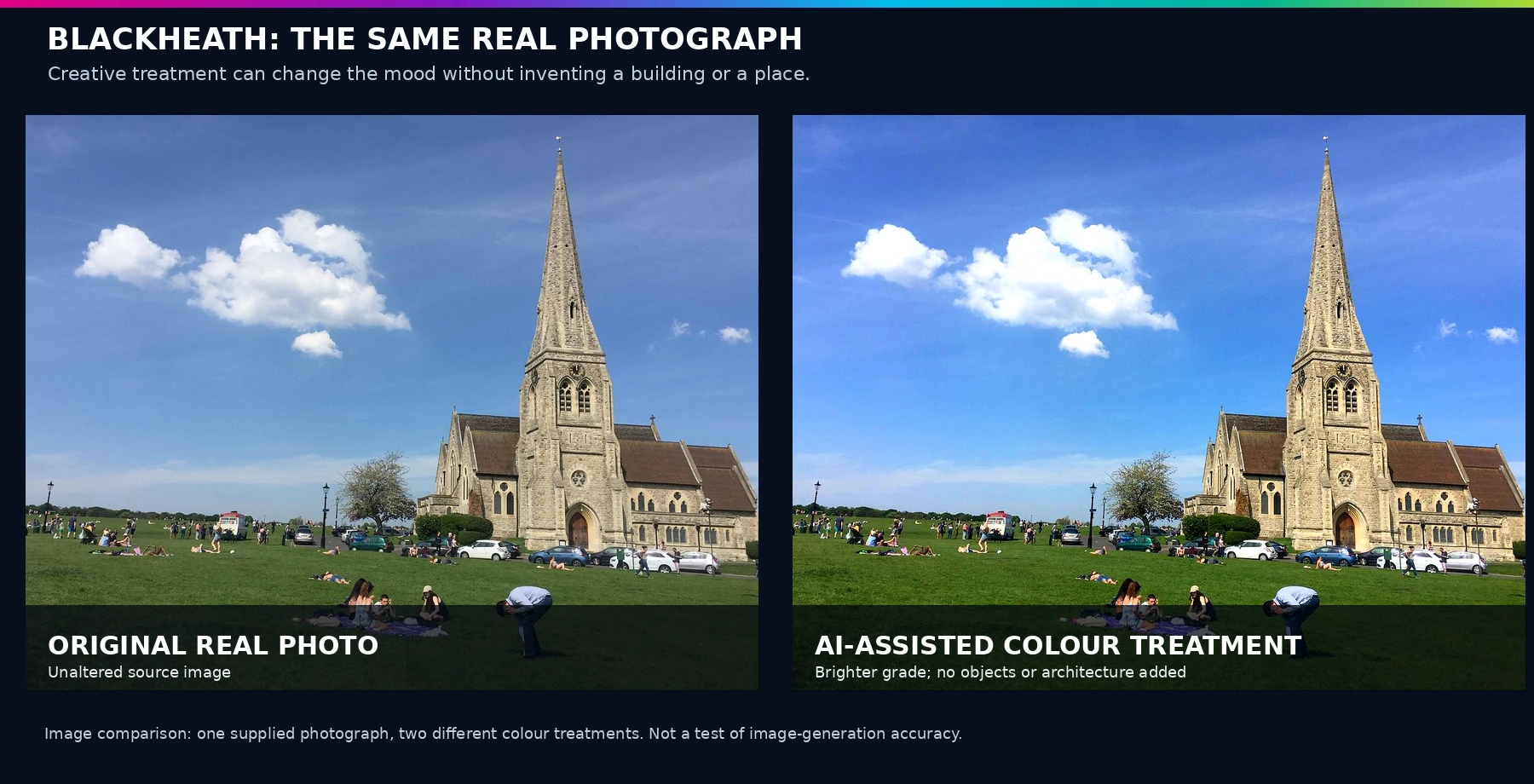
Crucially, neither version invents buildings, pathways, hotel rooms or visitors. The historic church remains the same church.
A colour grade might make a photograph more attractive in a social feed, but it can also change the impression of weather, lighting and atmosphere. When accuracy matters — for example, in an accommodation listing — visual enhancement must remain faithful to reality.
Which would you rather see in a local editorial: a quieter, unaltered photograph, or a more vibrant version of exactly the same scene?
Now compare two posters for a fictional local event
The next example deliberately contrasts a plain do-it-yourself design with a much more polished AI-assisted creative treatment.
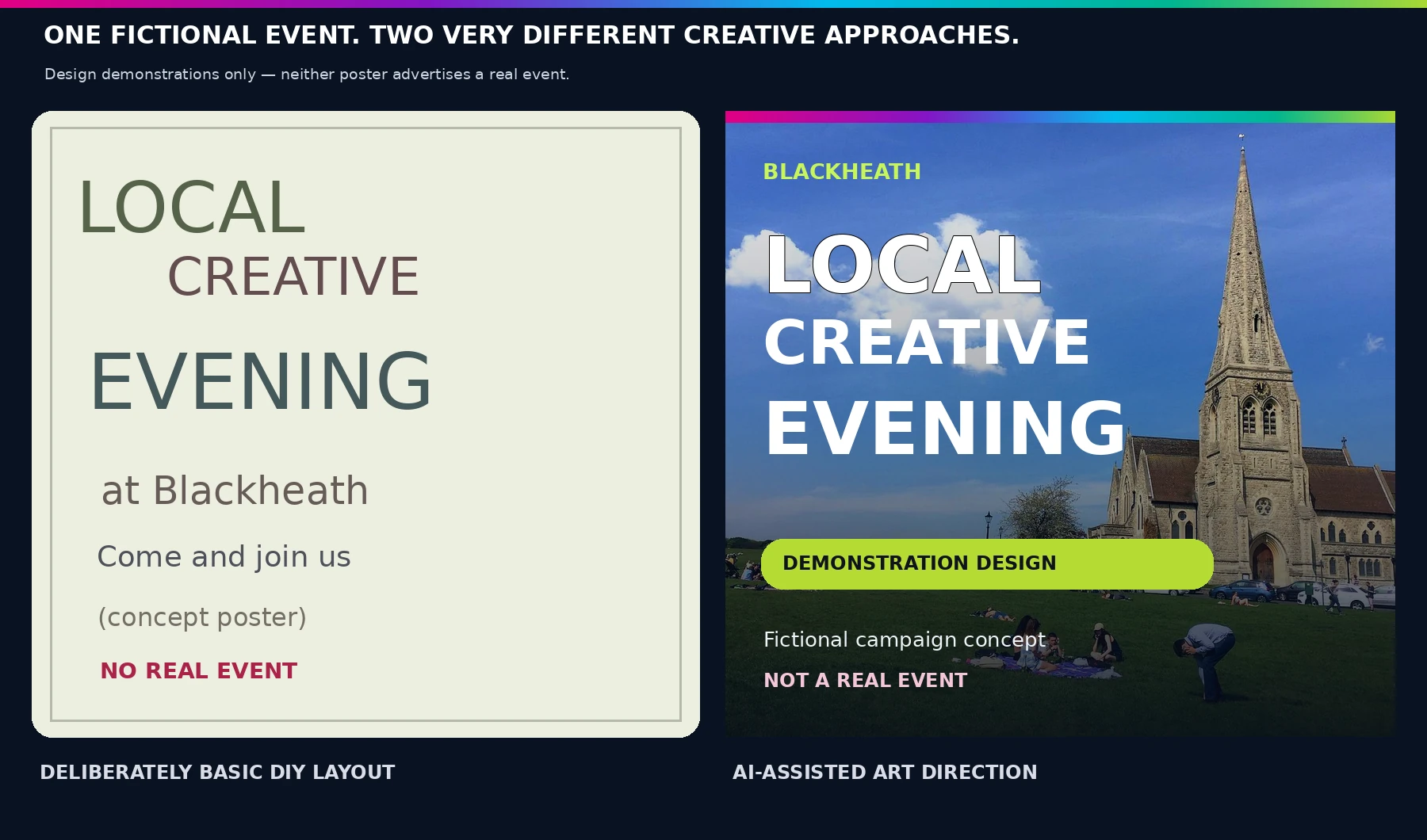
Both advertise a fictional Blackheath creative evening. There is no date to book, no tickets for sale and no actual event behind either poster; the comparison exists solely to illustrate two different approaches to design.
But there is an important catch. This is not a fair controlled test of AI against human creativity. We've intentionally made the first example basic and the second professionally art-directed. A talented human designer using Canva, Photoshop, paper and pen, or another tool could easily create work as good as — or better than — the polished version.
That's the point. An attractive result depends on typography, hierarchy, composition, suitability for the audience and creative judgement. An AI tool can help produce assets; it cannot guarantee good art direction.
A polished but generic poster can still perform badly. A rough handwritten sign can have enormous charm when its personality is genuine and the message is clear.
Authenticity matters most when an image makes a factual claim
There's a useful line between illustrating something and claiming to show something.
A whimsical computer-generated illustration for a children's storytelling class is obviously a creative concept. A fabricated photograph purporting to show the interior of a real restaurant is a factual representation — and may mislead someone deciding where to spend their money.
Enjoying this? Get more in your inbox
Local news, events and stories from Blackheath & Greenwich, delivered to your inbox fortnightly. Quick and simple to sign up, and you can opt out any time.
We'll email you a link to confirm. By signing up you agree to receive our newsletter, and you can opt out any time. See our Privacy Notice.
The UK's Advertising Standards Authority has explained that advertising imagery, not only words, can create a misleading overall impression. Its guidance notes that images should not exaggerate or misrepresent what consumers will actually receive.
Read the ASA guidance on misleading advertising imagery.
In practice, that suggests some sensible editorial questions:
It isn't necessary to abandon visual imagination. It is necessary to take responsibility for the impression the work creates.
What does the research actually show?
A February 2026 study by Ipsos for the BBC found that 78% of surveyed UK adults preferred human-written online news, while 58% said AI in media made them nervous.
The research surveyed 2,000 UK adults aged 16–75 in April–May 2025 and also used qualitative workshops. It showed particular concern about generative AI replacing human reporting and creating editorial imagery in news.
That does not mean 78% of people reject AI marketing posters. News reporting, advertising, design enhancement and artistic illustration are different activities. But the findings support an important conclusion: audiences care who is accountable for content, and whether they can trust what they see.
The Advertising Standards Authority likewise warns that a disclosure does not make an otherwise misleading visual claim acceptable.
Why Welcome to Blackheath & Greenwich is joining the debate
We think it's important to be open about our own practices.
Welcome to Blackheath & Greenwich is a free-to-read community platform. Researching local stories, creating documentaries, maintaining directories, publishing event information and keeping the website running requires substantial work and expense.
We sometimes use AI-generated illustrations when suitable original or properly licensed photographs are unavailable. We also use real photography, original filming and professionally directed visual content whenever we can.
We do not believe an illustration should be presented as documentary evidence of a real place or event. When a photograph is intended to show an actual business, accommodation, product or landmark, accuracy should come first.
That distinction is more important than whether a tool uses AI behind the scenes.
We are also part of the creative community. Photography, filmmaking, writing, art direction and graphic design deserve to be valued. The question isn't whether human creativity has a future; it's how new tools can be used responsibly without replacing the originality and judgement that make it worthwhile.
And if local readers think we should change the way we label, source or display illustrations, we want to know.
Have your say — should AI imagery change where we spend our money?
Our reader poll asks whether AI-created imagery affects your willingness to support a local business. Choose the answer that best reflects your view, then tell us why.
Are you more forgiving when a small business has limited funds? Do food photographs need to be real, while creative event posters can be imaginative? Are you happy with subtle photo editing but uncomfortable with completely invented scenes?
If you're a designer, artist or photographer, what do you wish businesses understood? If you run a small business, what would genuine professional design cost in your circumstances, and what difference would it make?
Vote below and join our moderated comments. You don't have to agree with us — or with each other.
We're interested in genuine local views, not a shouting match. We will use the feedback to inform our future editorial standards.
*Reader poll results represent people who choose to participate; they are not a representative survey of residents or businesses. Examples in this article are clearly marked and do not advertise real events.*
---
Research and editorial context: Ipsos / BBC, February 2026 · Advertising Standards Authority, September 2025. The Facebook conversation discussed here is used to illustrate differing opinions; individual commenters are not presented as representative of the wider public.
What do you think?
Vote in our reader poll and share your own experience. We welcome different perspectives; please keep comments constructive and respectful.
Community poll
Would AI-generated images put you off supporting a local business?
One response per browser. Results reflect people who choose to vote, not a representative public survey.
102 votes so far
Enjoyed this? Get more in your inbox
Local news, events and stories, delivered to your inbox fortnightly. Opt out any time.
We'll email you a link to confirm. By signing up you agree to receive our newsletter, and you can opt out any time. See our Privacy Notice.
Useful answers